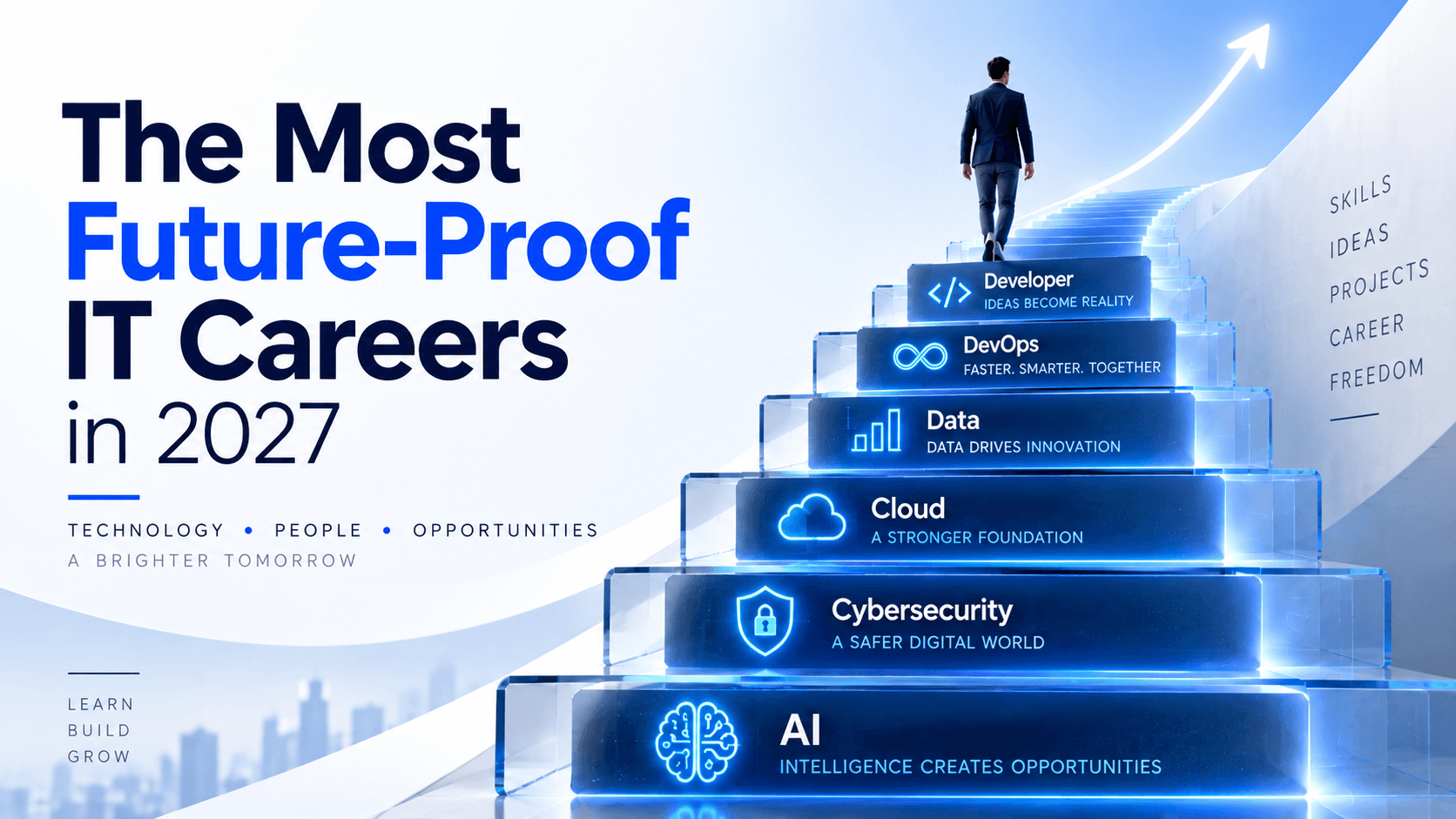
The Most Future-Proof IT Careers in 2027
The IT job market is changing rapidly. A few years ago, traditional frontend developers, backend developers and system administrators were among the most sought-after technology professionals.
Today, artificial intelligence, automation, cybersecurity, cloud computing and data are becoming increasingly important.
According to the World Economic Forum Future of Jobs Report 2025, some of the fastest-growing roles include Big Data Specialists, AI and Machine Learning Specialists and Software Developers. Cybersecurity skills are also becoming increasingly valuable.
So which IT careers could be particularly promising in 2027?
1. AI Engineer
It is difficult to start this list with anything else.
An AI Engineer builds and integrates solutions that use artificial intelligence.
This does not always mean training entirely new models from scratch. In many cases, the role involves integrating existing AI models into applications, enterprise systems and business processes.
Useful technologies include:
- Python
- AI model APIs
- Large Language Models
- RAG
- vector databases
- AI agents
- AWS, Azure or Google Cloud
AI and Big Data are currently among the skills expected to grow most rapidly in importance over the coming years.
2. AI Agent Developer
This is a relatively new specialization that could become significantly more important by 2027.
Instead of creating a traditional chatbot, an AI Agent Developer builds systems capable of performing more complex tasks autonomously.
An AI agent may be able to:
- analyze documents
- interact with APIs
- perform actions in other applications
- analyze data
- generate reports
- complete multi-step workflows
As the industry moves from simple chatbots toward more autonomous AI systems, demand for professionals who can build these solutions is likely to increase.
3. Cybersecurity Specialist
The more systems companies move to the cloud and the more extensively they use AI, the larger the potential attack surface becomes.
Cybersecurity is therefore unlikely to be a temporary trend.
Some particularly interesting areas include:
- cloud security
- application security
- SOC
- penetration testing
- DevSecOps
- AI security
Professionals who combine security expertise with knowledge of modern AI systems may be especially valuable.
4. Data Engineer
AI cannot work effectively without data.
Companies collect enormous amounts of information, but someone still needs to collect, process, clean and prepare that data for analytics platforms and AI systems.
That is where Data Engineers come in.
They often work with technologies such as:
- Python
- SQL
- Apache Spark
- Kafka
- Snowflake
- Databricks
- AWS
- Azure
- Google Cloud
Big Data Specialists are among the fastest-growing roles identified by the World Economic Forum.
5. Cloud Engineer / Cloud Architect
Companies continue to move applications and infrastructure to the cloud.
AWS, Microsoft Azure and Google Cloud now form the foundation of a large part of modern IT infrastructure.
Cloud Engineers design, deploy and maintain cloud environments.
An especially valuable combination of skills could be:
Cloud + DevOps + Security + AI
Someone who understands several of these areas may be significantly more valuable to an organization than a specialist focused on only one technology.
6. DevOps / Platform Engineer
Infrastructure automation and deployment pipelines will remain extremely important.
DevOps Engineers and Platform Engineers frequently work with:
- Docker
- Kubernetes
- Terraform
- Jenkins
- GitHub Actions
- AWS
- Azure
- monitoring and observability
AI will automate some routine DevOps activities, but infrastructure supporting modern AI systems may also become increasingly complex.
7. Software Developer Working with AI
Will AI replace programmers?
A more realistic scenario is that developers who use AI effectively will complete tasks much faster than developers who do not.
Software and Applications Developers are still considered among the faster-growing occupations by the World Economic Forum.
The nature of software development, however, is changing.
Developers will increasingly work with:
- AI agents
- code generation tools
- automated code review
- AI-generated tests
- automated documentation
- AI-assisted repository analysis
Programming alone may therefore no longer be enough.
The ability to work effectively with AI could become an important part of software engineering.
8. MLOps Engineer
A company may build an excellent AI model, but another challenge remains: how should it be deployed, monitored and updated in production?
This is where MLOps comes in.
MLOps combines Machine Learning, DevOps and cloud technologies.
An MLOps Engineer may be responsible for the technical lifecycle of AI models, from development and deployment to production monitoring and maintenance.
As more companies build and deploy their own AI systems, demand for these skills may continue to grow.
9. AI Security Engineer
One of the most interesting emerging specializations is AI security.
Large Language Models and AI agents create entirely new security challenges.
Examples include:
- prompt injection
- confidential data leakage
- excessive AI agent permissions
- unsafe execution of actions
- manipulation of AI responses
- incorrect decisions caused by AI hallucinations
Professionals who understand both artificial intelligence and cybersecurity could become particularly valuable.
10. AI Product Manager / AI Consultant
Not every future-proof IT role requires daily programming.
Companies also need people who can identify realistic and profitable ways to use AI.
An AI Product Manager or AI Consultant should understand:
- AI capabilities
- limitations of AI models
- business processes
- implementation costs
- security
- user needs
For many organizations, the biggest challenge will not be gaining access to AI.
The real question will be:
Where can AI actually create measurable business value?
Which Skills Should You Learn Before 2027?
If you are planning or developing a career in IT, some of the most interesting skills currently include:
AI, Python, SQL, cybersecurity, cloud, Docker, Kubernetes, automation and data analysis.
This does not mean everyone needs to become a Machine Learning Specialist.
A better strategy may be to combine your existing specialization with AI.
Developer + AI.
DevOps + AI.
Cybersecurity + AI.
Cloud + AI.
Data + AI.
The technology job market will continue to evolve. Being able to learn new technologies quickly and apply them effectively may therefore become one of the most important professional skills.
Conclusion
2027 is unlikely to mark the end of traditional IT careers.
However, the responsibilities within many of those roles are likely to change considerably.
The areas currently showing particularly strong potential include:
artificial intelligence, data, cybersecurity, cloud and automation.
The best strategy does not necessarily have to involve changing your entire career path.
In many cases, expanding your existing expertise with AI skills and learning how to use modern tools effectively may be a much better approach.
In the future, knowing one specific tool may matter less.
The ability to adapt quickly to new technologies may matter much more.