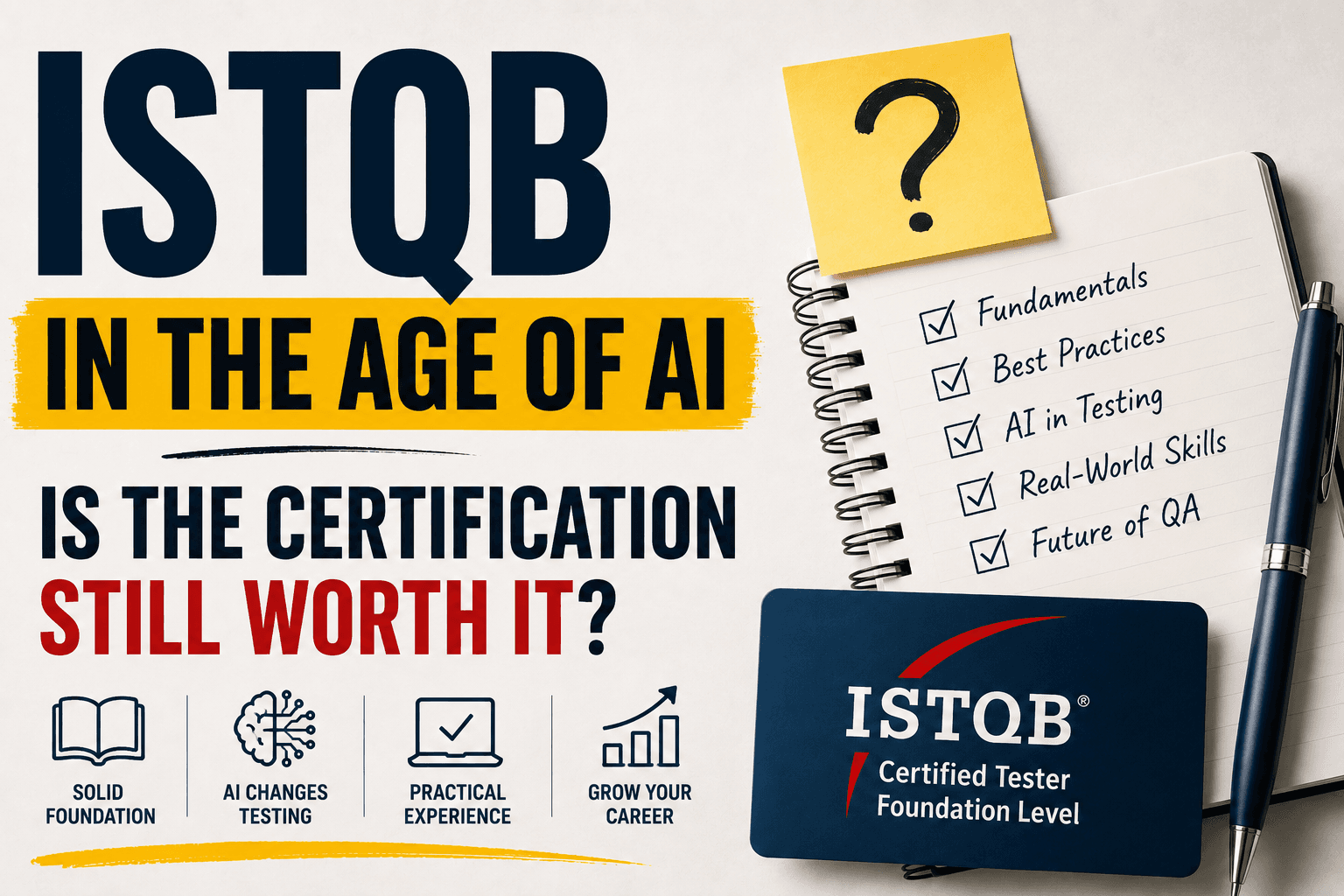
ISTQB in the Age of AI — Is the Certification Still Worth It?
A few years ago, the development path of a software tester looked quite standard: testing fundamentals, ISTQB, some SQL, API testing, Postman, and later maybe test automation.
Today, things look a bit different because artificial intelligence has entered the IT world in a big way. We have ChatGPT, Copilot, tools for generating test cases, analyzing requirements, and even helping with automated test scripts.
And this raises an important question: Does ISTQB still make sense?
In my opinion — yes.
But it is important to understand what this certification is, and what it is not.
ISTQB does not automatically make someone a good tester. It does not replace practice, experience, working with real applications, or logical thinking. But it can provide a very solid foundation, especially for people who are just starting out or want to organize their testing knowledge.
AI Helps, But It Does Not Think for the Tester
AI can generate test cases, checklists, scenarios, or sample test data. And that can be really useful.
The problem starts when someone treats an AI-generated answer as the final truth.
A model can miss important risks. It can suggest tests that look reasonable at first glance but are too superficial in practice. It can generate code that looks professional but contains mistakes. It can also fail to fully understand the business context of an application.
That is why a tester still needs to understand:
- why we test,
- what risk means,
- how to design test cases,
- how to analyze requirements,
- how to report defects,
- the difference between retesting and regression testing,
- when testing is sufficient.
And this is exactly where ISTQB fundamentals still have value.
What Does ISTQB Give You?
For me, the biggest value of ISTQB is that it helps structure your knowledge.
The certification shows that testing is not just “clicking through an application”. Testing is a process. It involves analysis, communication, risk management, and conscious decision-making.
ISTQB also helps you understand basic terms that appear regularly in a tester’s daily work. This makes it easier to communicate with the team, write better test cases, and think about product quality in a more structured way.
This is especially important for beginners. At the start, it is very easy to learn in a chaotic way: a bit from YouTube, a bit from work, a bit from courses, and a bit from documentation. ISTQB can work like a framework that organizes the topic of software testing.
What Does ISTQB Not Replace?
However, one thing has to be said clearly: the certification alone is not enough.
You can pass the exam and still not be able to test an application well. You can know the definitions but fail to find an important bug. You can solve practice exams but struggle with a practical task during a job interview.
ISTQB does not replace:
- practice,
- testing real applications,
- API knowledge,
- basic SQL skills,
- working with tools,
- test automation,
- communication with the team,
- understanding the business.
That is why, in my opinion, ISTQB should be treated as a foundation, not as the final goal.
Does AI Reduce the Value of ISTQB?
In my opinion, no. Actually, the opposite may be true.
The more AI tools we use, the more we need people who can judge whether a generated answer actually makes sense.
If AI creates test cases, the tester must know whether those test cases really cover relevant risks.
If AI writes an automated test, the tester must understand what that test actually verifies.
If AI analyzes requirements, the tester must be able to notice what is missing.
Without solid fundamentals, it is very easy to fall into the trap of thinking: “AI generated it, so it must be correct.”
And that is a dangerous approach.
Is ISTQB Foundation Level Worth It?
If someone is just starting in software testing or wants to organize their fundamentals, then in my opinion ISTQB is worth considering.
Not because the certificate guarantees a job. It does not.
But it can help you understand testing better, prepare for job interviews, and build a solid base for further development.
The best approach is to connect theory with practice. Do not just read definitions. Apply them to real examples: forms, online shops, APIs, requirements, bug reports, or test cases.
Summary
ISTQB is still valuable in the age of AI, but not as a “magic certificate”.
It is valuable as a foundation.
AI can speed up a tester’s work, but it does not replace understanding quality, risks, requirements, and testing processes. A good tester should know how to use AI, but also how to critically evaluate what AI generates.
That is why the best direction is not: ISTQB or AI.
The best direction is: ISTQB as a foundation, practice as development, and AI as a tool that helps you work faster but does not replace thinking.