Many people create one CV, save it as a PDF, and then send exactly the same document to every job opening for months.
Manual Tester, QA Engineer, Automation Tester, API Tester, and sometimes even Project Manager — the same CV is used everywhere.
It is convenient, but usually not very effective.
This does not mean that you need to create a completely new CV for every application. A better approach is to prepare one detailed master CV and adjust its most important sections to match a specific job offer.
Recruiters Do Not Spend Several Minutes Analysing Your CV
At the beginning of the recruitment process, a CV is often reviewed very quickly. Recruiters mainly look for information that confirms whether a candidate matches the position.
For example, if a company is looking for a tester with experience in:
- API testing,
- Postman,
- SQL,
- Jira,
- Agile processes,
- basic test automation,
these skills should be easy to find in your CV.
You may have all the required skills, but if they are hidden in a long job description or only appear on the second page, the recruiter may simply overlook them.
Your CV should not force the reader to search for the most important information.
One General CV May Not Fit Different Roles
Even job offers with similar titles can have very different requirements.
One company may be looking for a manual tester responsible for analysing requirements and designing test cases.
Another may need a more technical candidate with experience in API testing, SQL, logs, and developer tools.
A third company may expect test automation experience with Playwright, Cypress, or Selenium.
When you send the same universal CV to all of these companies, you try to present all your skills at once. As a result, the document may become too general and fail to highlight what matters most for a specific position.
A strong CV does not need to include everything you have ever done. Its main purpose is to show why you are a good match for the role.
Do You Need to Rewrite Your CV Every Time?
No.
The best solution is to create a detailed master CV that includes all relevant information:
- work experience,
- projects,
- technologies,
- tools,
- training,
- certifications,
- achievements,
- responsibilities.
Before sending an application, you can use this document to create a tailored version.
In practice, this often takes only a few minutes.
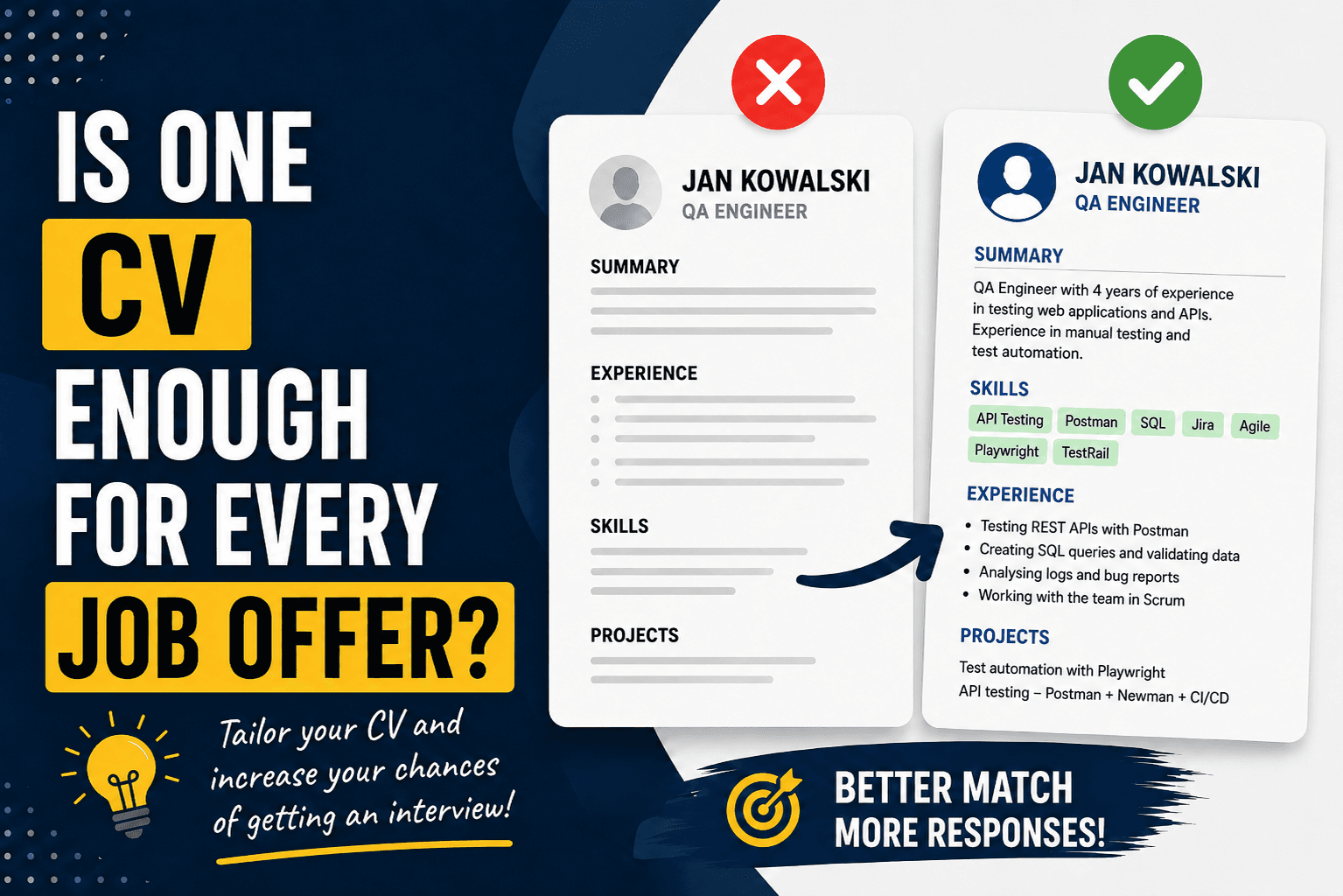
You do not need to rewrite the entire CV. Usually, it is enough to change the order of information, shorten less relevant sections, and make the required skills more visible.
What Should You Change Before Sending an Application?
Professional Summary
The professional summary is usually placed at the top of the CV, so it should immediately show that you fit the role.
Instead of writing:
“I am an ambitious, communicative, and motivated person looking for new professional challenges,”
it is better to use a specific description:
“QA Engineer with four years of experience in testing web applications and REST APIs. Experienced with Postman, SQL, Jira, and browser developer tools. I also have basic experience in test automation with Playwright.”
The second version immediately tells the recruiter what you can do and where your experience lies.
Your professional summary should be adjusted depending on whether you are applying for a manual testing, test automation, QA specialist, senior, or team lead position.
Technologies and Tools
Not every technology needs to be presented with the same level of importance.
If SQL, Postman, and REST API appear repeatedly in the job description and you have experience with them, they should be placed near the top of your skills section.
This does not mean copying every keyword from the job offer. Your CV should only contain skills you genuinely have.
Tailoring a CV is not about pretending to be the perfect candidate. It is about presenting your real experience in the most relevant way.
Work Experience
Descriptions of previous roles should not consist only of general responsibilities.
Instead of writing:
- performing tests,
- reporting bugs,
- working with the team,
you can be more specific:
- designing and executing functional tests for web applications,
- testing REST APIs with Postman,
- creating SQL queries for data validation,
- analysing logs and production issues,
- working with developers and business analysts to clarify requirements,
- participating in test planning and risk assessment.
In a tailored CV, the responsibilities most relevant to the new role should appear first.
Projects
Projects are especially important for people entering the industry or changing their area of specialisation.
When applying for a test automation role, highlight a project built with Playwright, Cypress, or Selenium.
When the position focuses on API testing, present a project involving Postman, Swagger documentation, response validation, and data verification.
You do not need to include every project you have completed. Choose the ones that best support the application.
Order of Information
Tailoring a CV is often more about changing the order of information than adding new content.
If automation is a key requirement, do not hide Playwright or Cypress at the end of the second page.
If API testing is the main focus, Postman, REST API, and SQL should be clearly visible.
The most relevant information should appear as early as possible.
Tailoring Your CV for ATS Systems
Some companies use Applicant Tracking Systems, commonly known as ATS, to organise and initially analyse applications.
These systems may search CVs for specific job titles, technologies, tools, and skills.
If the job description uses the term “REST API” but your CV only says “service testing,” the system may not interpret your experience correctly.
That is why it is worth using clear and commonly recognised terms such as:
- REST API,
- Postman,
- SQL,
- Jira,
- Selenium,
- Cypress,
- Playwright,
- regression testing,
- functional testing,
- CI/CD.
However, you should not repeat the same keywords unnaturally in every paragraph. Your CV still needs to be clear and readable for a person.
The Biggest Mistake When Tailoring a CV
The biggest mistake is adding skills that you do not actually have.
If a job offer requires Selenium, do not add Selenium to your CV only because you watched a few tutorials.
When your knowledge of a technology is basic, describe it honestly:
- basic knowledge of Playwright,
- fundamentals of test automation,
- personal project created with Cypress,
- SQL knowledge for data validation.
A tailored CV should make your real skills more visible, not create a false image of your experience.
Any major gap between your CV and your actual knowledge will quickly become clear during a technical interview.
Is It Worth Creating Several CV Versions?
Yes, especially if you are interested in different career paths.
For example, you can prepare:
- a CV for manual testing roles,
- a CV for technical QA roles involving API testing and SQL,
- a CV for test automation positions,
- a CV for senior or leadership roles.
Each version can use the same core information, but the professional summary, order of skills, and description of experience should be different.
This means you do not need to rebuild your CV before every application. You can choose the closest version and make a few smaller changes based on the job offer.
How Can You Quickly Tailor a CV to a Job Offer?
Before applying, spend a few minutes analysing the job description.
First, identify five or six requirements that appear to be the most important. Then check which of them you genuinely meet.
Ask yourself:
- Are the most important requirements visible on the first page?
- Does my professional summary match the role?
- Do I use the same standard technology names as the job description?
- Is my most relevant experience hidden in long paragraphs?
- Have I described specific responsibilities and results?
- Have I removed information that adds little value to this application?
If you can answer “yes” to most of these questions, your CV is probably sufficiently tailored.
Is One CV Enough for Every Job Application?
One master CV — yes.
One identical version sent everywhere — usually not.
Different companies look for different skills, even when the job titles sound similar. Tailoring your CV helps you show that your experience matches the specific requirements of the role.
You do not need to change the whole document. In many cases, it is enough to update the professional summary, change the order of technologies, and adjust a few points in the work experience section.
A few extra minutes spent tailoring your CV can significantly increase the chance that your application will not be rejected at the first stage.
The candidate who includes the most information does not always win.
The candidate who presents the right information in the right place has the advantage.