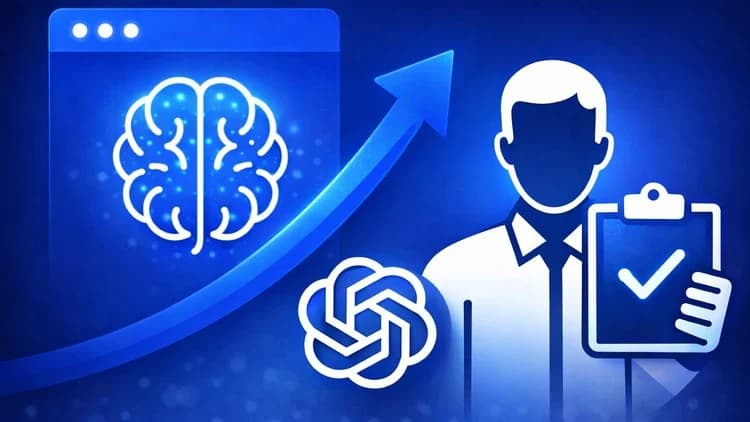
This may include tools such as ChatGPT, Claude, Gemini, GitHub Copilot, and other specialized AI systems.
However, it is worth going beyond simply asking AI basic questions.
Useful skills include:
writing effective prompts,
providing the right context,
analyzing large amounts of information,
creating repeatable AI workflows,
working with AI agents,
validating AI-generated results,
automating multi-step tasks.
The real advantage will increasingly belong not to someone who simply “knows how to use ChatGPT,” but to someone who can redesign their workflow so that AI genuinely saves time and improves productivity.
2. Process Automation
Another highly valuable skill is automation.
Almost every organization has repetitive tasks such as:
In the past, automating many of these activities often required custom software.
Today, the possibilities are much broader.
We now have access to low-code and no-code platforms, workflow automation tools, APIs, and AI-powered solutions.
This means it is worth learning to look at your work from a process perspective and ask yourself:
Do I really need to perform this task manually every single time?
The ability to identify repetitive processes and automate them can be valuable in almost any profession.
3. Data Analysis
Companies collect enormous amounts of data. However, simply having data does not automatically create value.
You need to know how to understand it.
That is why it is worth developing skills related to:
Not everyone needs to become a Data Scientist.
In many situations, it is far more useful to be able to independently answer questions such as:
“Why did sales decrease?”
“Which product generates the most revenue?”
“Which marketing channel performs best?”
“At what stage are users abandoning our product?”
AI is also lowering the barrier to entry in data analysis because it can help create SQL queries, formulas, visualizations, and interpretations.
However, one thing remains unchanged: you still need to understand the data and determine whether the result actually makes sense.
4. Cybersecurity
As technology becomes more important, security becomes more important as well.
Cybersecurity is no longer relevant only to specialized security teams.
Developers should know how to avoid introducing vulnerabilities.
Administrators should understand secure infrastructure configuration.
Employees should be able to recognize phishing attempts.
People using AI tools should understand which types of sensitive information should not be shared with external systems.
It is worth understanding the basics of:
phishing and social engineering,
password management and MFA,
access control,
application security,
API security,
data protection,
cloud security,
AI-related security risks.
Cybersecurity will not only remain a separate specialization. It will increasingly become a supporting skill required across many different roles.
5. Cloud Computing
AWS, Microsoft Azure, and Google Cloud have been important parts of the technology industry for many years, and this is unlikely to change anytime soon.
That does not mean everyone needs to become a Cloud Architect.
However, it is useful to understand concepts such as:
what cloud computing is,
the difference between IaaS, PaaS, and SaaS,
how virtual machines work,
what containers are,
how data is stored in the cloud,
how scaling works,
what serverless computing is,
how applications are monitored,
how access and costs are managed.
Cloud computing is also becoming increasingly connected with artificial intelligence.
AI models need infrastructure in order to run, scale, store data, and remain secure.
Understanding the basics of cloud technology can therefore be valuable across many technical roles.
6. Programming Fundamentals
Is learning programming still worth it in the age of AI?
Yes — but the way we learn programming is likely to change.
Memorizing syntax may become less important.
Understanding fundamental concepts will become much more valuable.
These include:
AI can already generate large amounts of code.
However, someone still needs to understand what the code is supposed to do and whether the generated solution is correct.
That is why even a basic knowledge of languages such as Python, JavaScript, or TypeScript can remain extremely useful.
Developers may write less code manually in the future, but they will likely need a stronger understanding of the systems they build.
7. APIs and System Integration
This is one of the less flashy but extremely practical technology skills.
Modern applications rarely operate completely independently.
An online store may need to communicate with:
payment systems,
shipping companies,
invoicing software,
CRM platforms,
email marketing tools,
analytics platforms,
AI services.
In many cases, these systems communicate through APIs.
That is why it is useful to understand:
what a REST API is,
how requests and responses work,
GET, POST, PUT, and DELETE methods,
JSON,
HTTP status codes,
authentication,
tokens,
webhooks.
API knowledge is valuable even for people who are not professional programmers.
It allows you to connect existing services instead of building everything from scratch.
In a world of automation and AI agents, this skill may become even more important.
8. DevOps, CI/CD, and Infrastructure as Code
Modern software development does not end when the code is written.
Applications still need to be:
built,
tested,
deployed,
monitored,
updated,
secured.
That is why a basic understanding of DevOps is becoming valuable for an increasing number of technology professionals.
It is worth understanding concepts such as:
CI/CD,
pipelines,
Docker and containers,
GitHub Actions,
GitLab CI,
Jenkins,
Infrastructure as Code,
Terraform,
GitOps.
You do not need to master all of these technologies.
What matters most is understanding the entire process from a code change to a working production application.
That broader perspective makes it much easier to collaborate across development, operations, testing, and security teams.
9. Monitoring and Observability
The more complex technology systems become, the more important one simple question becomes:
What is actually happening inside our application?
The fact that a system is running does not necessarily mean it is running well.
It may be too slow.
It may generate errors.
It may consume too many resources.
It may only fail for a small group of users.
That is why it is worth understanding the basics of:
monitoring,
metrics,
logs,
alerts,
dashboards,
traces,
performance analysis.
Popular technologies in this area include Grafana, Prometheus, and monitoring services available directly in AWS, Azure, and Google Cloud.
Observability is no longer just an optional addition to modern applications.
For large and complex systems, it is one of the foundations of effective maintenance and troubleshooting.
10. Critical Thinking About Technology
The final skill may be the most important of all.
It is not about knowing one particular tool.
It is about understanding when and how technology should be used.
AI may generate an answer that looks convincing but is completely wrong.
A dashboard may contain correct numbers but lead to the wrong conclusion.
An automation may perfectly execute a process that should not exist in the first place.
A new technology may look impressive during a presentation but fail to solve any real business problem.
As technology becomes more powerful, the ability to ask the right questions becomes even more important.
It is worth asking:
What problem am I trying to solve?
Is technology really necessary here?
How can I verify the result?
What risks does this solution introduce?
Is the data reliable?
What happens if the system makes a mistake?
Is there a simpler solution?
This becomes particularly important when working with artificial intelligence.
The more tasks AI can perform, the more valuable human judgment and critical thinking become.
Do You Need to Learn All of These Skills?
No.
And trying to do so would probably not be the best strategy.
The number of technologies available today is practically unlimited.
A better approach is to build strong foundations in one area and gradually expand into complementary skills.
A developer might combine programming with AI, cloud computing, and DevOps.
A software tester might combine automation, APIs, AI, and CI/CD.
A data analyst might focus on SQL, visualization, and AI.
A marketing specialist might combine AI, automation, and data analysis.
A business owner might learn how to integrate tools and automate processes without becoming a programmer.
In many cases, the most valuable advantage will not come from mastering one isolated skill.
It will come from creating the right combination of skills.
How to Start Developing Technology Skills
One of the biggest mistakes is trying to learn everything at once.
Choose one area.
Learn the fundamentals.
Then build a small practical project.
If you are learning AI, automate part of your daily work.
If you are learning SQL, analyze a real dataset.
If you are learning cloud computing, deploy a simple application.
If you are learning APIs, connect two existing services.
If you are learning DevOps, create a simple CI/CD pipeline.
Technology is best learned through practice.
The goal is not to memorize another definition or tool.
The goal is to understand how to use technology to solve a real problem.
Summary
The coming years are likely to bring even faster technological change than we have seen so far.
It is impossible to predict exactly which tools will dominate five or ten years from now.
However, we can prepare for these changes by developing skills that remain useful regardless of the specific technology.
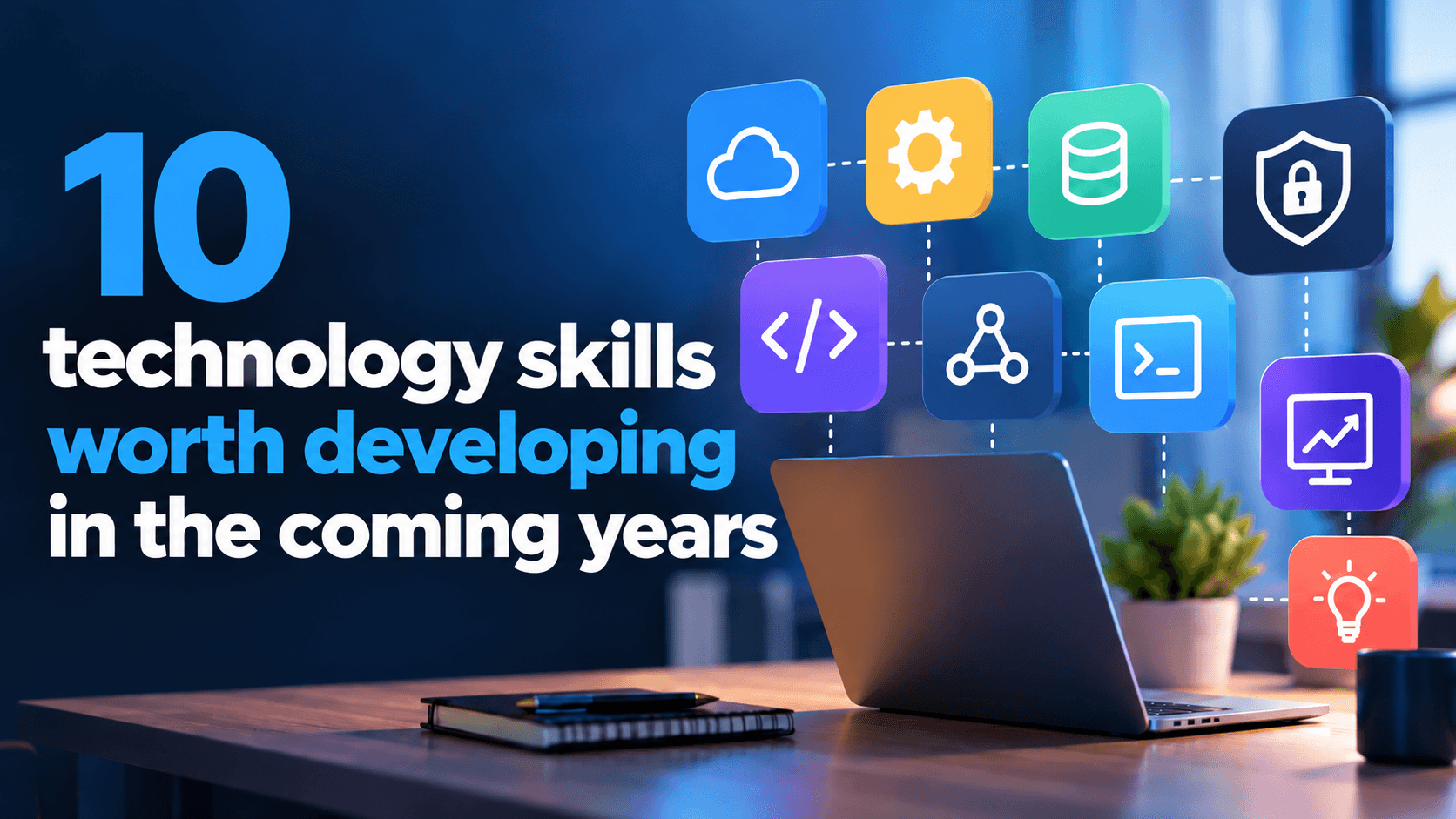
The 10 areas worth paying attention to are:
artificial intelligence and effective use of AI,
process automation,
data analysis,
cybersecurity,
cloud computing,
programming fundamentals,
APIs and system integration,
DevOps, CI/CD, and Infrastructure as Code,
monitoring and observability,
critical thinking about technology.
You do not need to become an expert in all of them.
The most important thing is to keep learning.
In a world where specific tools can change within months, the ability to quickly understand and adopt new technologies may become one of the most valuable professional skills of all.